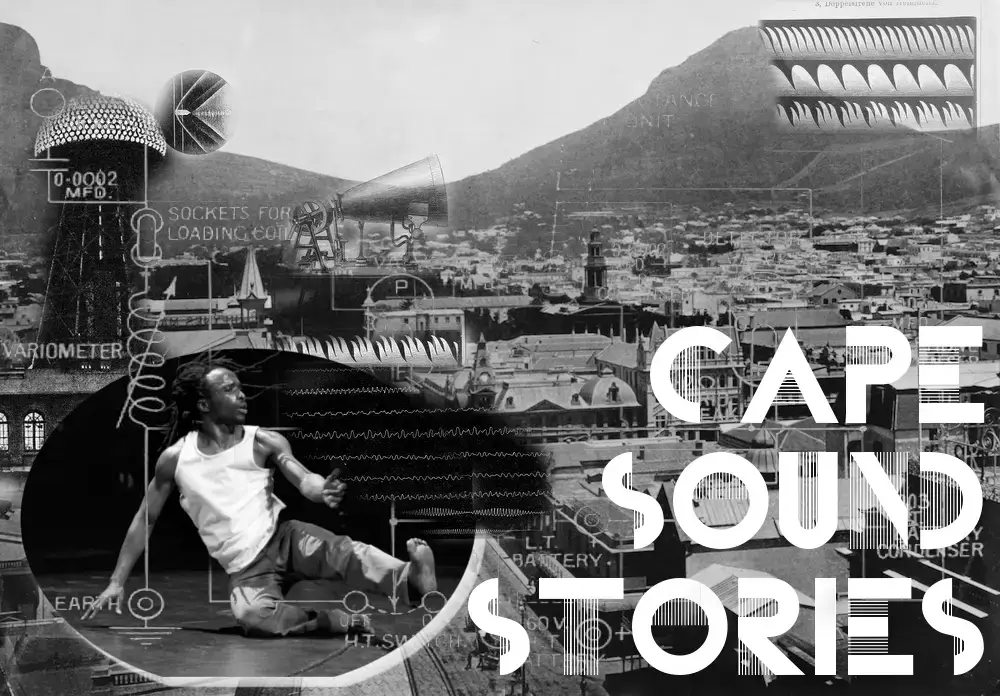
Cape Sound Stories: Background Research & Conceptual Grounding:
Lacuna:
In ‘Coping with the Past: creative perspectives on conservation and restoration’ (2010), Pedro Memelsdorff describes the various musicological approaches towards interpreting damaged, deteriorated and decayed musical manuscripts and scores. The voids, gaps left by lost notes and phrases, are referred to as lacuna. These cavities are often filled-in by musicologists, making educated guesses as to the missing notes and expressions based on the forms, trends and styles of the given periods and composers. However, purists often believe that lacuna should be preserved – requiring performances to offer fragmented renderings of the compositions that invite the listener to fill the voids. Lacuna become an unsolicited invitation for interpretation and invention, actually forming part of any musical practice.
Lacuna exist beyond the realms of musicology, and beyond the realms of notes and phrases. Recording and broadcast technologies brought about fundamental shifts in both the function of music and in listening and performance practice. And yet irrespective of its fidelity, any audio recording remains a subjectively sliced sample of musical culture. Recording enabled us to experience truly disembodied music for the first time – music removed from the physical presence of the performer. – The absence of bodies and wider social contexts creates huge voids to be filled: more lacuna.
Cape Town, District Six, Cape Jazz
District Six was named the Sixth Municipal District of Cape Town in 1867. Originally established as a mixed community of freed slaves, merchants, artisans, labourers and immigrants, District Six was a vibrant centre with close links to the city and the port.
The slave economy in Cape Town and rural surrounding areas simultaneously resulted in highly regulated and policed public space, as well as dynamic clandestine spaces where the syncretic blending of cultures and art forms from places as far afield as Mozambique, Indonesia, India, parts of West Africa and Europe with local indigenous music. However, to date little documentation exists as to the scope and form of the music that existed in this unique time and space.
Our initial research focus was to chart the historical and contemporary lineage of Cape Jazz, an urban popular music born of intercultural mingling, including significant exposure to early means of broadcast, and musical genres that are being continually re-interpreted and performed today, influencing a variety of styles and carnival forms that link contemporary performance across more than one hundred years, back to the birth of recording and before.
We explore through sound and performance how the memory of a place corrodes with time, how we reinterpret it every time we remember it, and how recorded heritage maps, mediates and distorts popular memory. Cape Sound Stories responds to these particular lacuna, whilst simultaneously addressing historical and political issues alongside issues of memory and archives.
Andile’ Personal Perspective.
Andile Vellum is a South African contemporary dancer and choreographer, based in Cape Town. Having lost his hearing at the age of five through contracting mumps, Andile’s engagement with sound and music is a unique one. He is able to sense only narrow frequency bands, but his sense of physical rhythm through vibrations is extremely heightened. His practice pivots upon his navigating of sonic lacuna.
Andile has developed a series of Choreographed pieces, drawing from his responses to archival research, personal and collected memories and a wealth of dance styles resonant to the cultures and influences present within South Africa in the early part of the 20th century, including Langarm, Vastrap, Square dancing and ballroom dancing. Andile has a personal connection with ballroom dancing as both his parents were professional ballroom dancers.
Politics, Social Change, Music and Sound Recording in South Africa.
The opening decades of the twentieth century mark a period of massive social, political and musical change within southern Africa, nowhere more vibrantly and tragically witnessed than in South Africa and, in particular, the Cape peninsula. Rapid industrialization from 1860, intense diamond mining, wars, mass rural to urban migration – both voluntary and forced, and rich inter-cultural exchanges all contributed to an unprecedented mixing of people in South African townships. There followed an explosion of popular hybrid cultural responses, performances and musical styles that would ultimately significantly shape global musical styles today. Recordings, radio and touring international performances were key and linked catalysts during this process, and the District Six Museum in Cape Town remains one of the continent’s most significant monuments to the vitality, destruction and regeneration of a township that uniquely contributed to the global phenomenon of Cape Jazz.
The period from 1910-1930 marks an incredibly fertile, and yet relatively undocumented, moment in the pre-history of South African Jazz. However, it is important to remember that the Cape had been a site of intercultural mingling for many decades, indeed centuries before-hand. Its inhabitants were already familiar with aspects of music and cultures from across the globe and the annual carnivals were already in full swing. The arrival of recording technology was pivotal to the musical developments during this period.“Distributors for three companies, EMI, HMV and Columbia were making recordings of American ‘coon songs’ and other popular styles available to Africans in South Africa as early as 1908, and music stores provided musicians with tonic sol-fa albums of the latest American songs. With the introduction of the electric recording and the inexpensive hand-wound spring gramophone (know to local Africans as ‘Sophiatown ma-windam’) in the mid-twenties, record sales increased rapidly.
In 1926 the overseas interests were joined by a local competitor, Gallo, which had connections with Decca in Britain. Before 1932 no studio recording plant existed in South Africa, but from 1928 Gallo and HMV sent local African artist to record in England, and in some cases recorded locally or in the countryside with mobile recording units. Gramophones were already established as symbols of status amongst Blacks of every degree of urbanisation, and not only the new elite but even migrant mine workers made special efforts to secure the £5-£10 purchase price.” (p.143 Coplan, The African Musician 1900-1960).
Rural to Urban migration continued to bring huge social and political changes that were fused and mapped in inter-ethnic cultural forms, and, especially, music-making. The mixing of musical styles was driven by the ready availability of recordings, and made possible by mass migrations, while rapid urbanization into South Africa’s sprawling townships was unprecedented, nowhere more so than in Cape Town’s most diverse and vibrant musical area, The Sixth Municipal District of Cape Town.
South African Music and Cape Jazz.
A grounding in understanding the musical developments across Africa in the years preceding and following the 1910-30 period aids us in fully understanding the social, political and musical developments of the time. The 1930s proved to be a crucial and contested time for the definition of a modern black African sound as non-tribal working class formed after a period of rapid industrialization, forced migrations, diamond digging and wars. Myriad local and international musical styles began to be mixed and often re-purposed in townships that were originally highly diverse in character and soundscapes. For example the Xhosa tula n’divile folk song began to be used to attract patrons into shebeens, Cape musicians adapted country dances like tickey draai, and musicians from Basutoland preferred famo music with homemade percussion and concertinas. Zulu musicians develop ingom’ebusuku ‘night music’, blending hymns, vaudeville and village songs, a precursor of isicathamiya made internationally famous by Ladysmith Black Mambazo and Paul Simon.
District Six eventually became a hotbed for South African Jazz and Cape Carnival Music. Musical influences and diversity in the period from 1887 to 1930 proved remarkable: local South Africans could hear light opera, travelling repertory drama companies from London, the music of European migrants from Portugal, England, Italy, and Ireland, of Lebanese and Chinese migrants, the music of Eastern European Jews and Scottish marching bands, and all against backdrop sounds of stream trains and louder, more urgent, more strident city noises. In 1913 national hero RT Caluza composed Silusapo or iLand Act, the first anthem of the South African Native National Congress, which offered a voice that was openly critical of the white authorities, by pointing to actual events that worried and angered black people. Local musicians were tuning guitars to their traditional five or six note scales, and makwaya music – associated with graduates of missions in Natal and Eastern Cape – blended European or American derived hymns, with African-composed pentatonic hymns, adapting traditional songs, ragtime, spirituals and more recent vaudeville pieces.
International recordings proved hugely popular as a taste for ballroom dancing, swing, Count Basie and Duke Ellington developed among some classes and would influence the emergence of a hotter, faster, jazzier Cape sound in the 1940s. Slums in townships were highly diverse as Africans, Indians, Chinese, whites (British, Lebanese, and East European Jews) mixed, and a slumyard dialect of flaaitaal (clever speech) combined Afrikaans, English, and African languages. Patrons in sheebeens in the 1930s could hear Tin Pan Alley songs and the sound of the igeja (a weeding hoe on a string) being hit for percussion, box guitars, and cowboy records by Gene Autry and Tex Ritter.Such diverse influences led both to musical hybridity and, at times, conflicts over music, language and identity. In District Six, some groups such as American and West Indian radicals began to denounce the New Year ‘Coon Carnivals’ for promoting hooliganism, and in 1939 the poet ID du Plessis and others including Scottish musicologist Percival Kirby, announced that ‘coons’ should abandon imported songs and return to the melodies of the country.
As part of our research we have gathered as many original recordings from the 1910-1930 period as possible to use as source material for the performance/installation sound design. Music that is reference yet never documented as audio has either been recreated/reinterpreted or the very absence of its recording has become a subject for interpretation through creative sound design and Andile’s choreography.
The list of styles is long and interwoven, including: the Cape Choirs, vocal groups and orchestras, Langarm, Ghoema, Klopse, Moppies, Nederlandsliedjies, Qasidah and music which was performed by District Six’s Eoan group which has its earliest roots exactly in Pop’16’s thematic period. As a more definitive example, marabi – the precursor to South African Jazz – has its roots in American jazz, and later American swing, Jubilee music, choral music, European touring repertory dramas, and local indigenous sounds.
Created in 1920s, marabi flourished in the 1930s to become an entire way of life, expressing a modern, urban, non-white identity. The 1920s and 1930s were a time when black leisure and freedom began to be heavily policed during a process that would ultimately lead to apartheid. Crucially, marabi was claimed by all regions, as an essentially national sound, yet it was extinct by the 1940s.
Sound Design and Audience Experience.
The audience itself are drawn into these explorations through vibrant and subtle interplay of sound and movement through an immersive 7.2 surround system; The score includes passages which are treated and processed to emphasis and utilise various sonic phenomena in order to further sonically engage the audience with concepts of lacuna; implementing multi-speaker diffusion, sub-bass frequencies, frequency ghosting, phase cancellation, and signal interference.
The installation creates a complex set of shifting relationships which simultaneously explore issues of power, access, movement and information. A curated performance-installation.
Cape Sound Stories Team:
Andile Vellem , born and raised in Qumbu in the Eastern Cape. Losing his hearing at the age of 5
through contracting mumps, this 39 year old performer began dancing at an early age inspired by
his parents who were ballroom dancers. With a training that includes acting, contemporary dance,
contact improvisation and improvisation he has been a company member of Remix Dance
Company for many years. He has worked with Hellen Kaz (USA), Ina Mogane, Adam Benjamin,
Mpho Mselela, Jay Pather , Jacqueline Dommisse and Tossie Van Tonder, Jaco Bouwer, Gerda
Konig (Germany), Malcolm Black, Neo Muyanga, David Toole and Lucy Hinds (UK), Faniswa Yisa,
Sharon M Watson and Mark Store (UK). Vellem has taught and led workshops in different schools
and colleges in the Western Cape and Kwa-Zulu Natal, collaborated with main streams schools
and schools with special needs and collaborated with different artists, leading workshops at
different schools and universities in America. He is one of the founder members of the Mixibility
Network of all the integrated dance companies. www.unmutedance.co.za/
Mphotseng Shuping , dancer, choreographer, sign language interpreter, Co-Founder and
manager of UnMute Dance Company. Shuping was professionally trained by Jazzart Dance
Theatre (1987-1991), she continued working as a professional dancer with the company from 1992
to 1997. After she left Jazzart she then focused on her dance teaching career, where she taught in
schools, community groups and dance companies around South Africa and abroad (1998 – 2004).
In 2005, Mpotseng joined Remix Dance Company as a teacher and performer. In 2013 She
co-founded Unmute Dance Company.
“Disability is not a challenge. Those cannot deal with disability”are a bigger challenge.
”
www.unmutedance.co.za/Dom Coyote
Dom Coyote is a musical director, theatre maker and writer of songs. He studied creative writing at
Dartington College of Arts, before gaining an apprenticeship with award winning theatre company
Kneehigh Theatre, of which he is still an associate artist. Since then, Dom has worked on projects
ranging from large-scale circus to one-on-one music installations and has traveled through South
Africa, South America and the UK with theatre and art projects. In 2014, he released his first
critically acclaimed album with anglo/swedish alt-folk band, Vena Portae, published by Domino
Records. With a background in hip-hop, electronica and alt-folk, Dom specialises in bringing
alternative music to the stage.
www.domcoyote.com
Noel Lobley
Noel Lobley is an ethnomusicologist and sound curator who works across the disciplines of music,
anthropology and sound studies to develop a series of international curatorial residencies. He
previously worked as a sound curator at the Pitt Rivers Museum, University of Oxford, where he
lectured in both music and anthropology, and where he continues to serve as a Research
Associate.
Noel’s research and practice in sound curation focuses on ethnographic field recordings and aims
to connect local musicians, artists and communities with institutions and audiences. Through
extensive fieldwork in sub-Saharan Africa, much of his creative practice takes sound and music
recordings out of archives and back among communities. He has collaborated with musicians,
sound artists, DJs, composers and performers in South Africa, the UK and throughout Europe and
the US to develop creative and responsible ways for recordings to be experienced in spaces
ranging from art galleries and museums to schools and township street corners.
Noel is the 2015 Curl Lecturer at the Royal Anthropological Institute (UK).
Nathaniel Mann
Nathaniel Mann was the Embedded Composer in Residence at Oxford University’s Pitt Rivers
Museum and Oxford Contemporary Music for 20 months. During this time he garnered a reputation
for creating diverse and engaging responses to the museum and its collections. Described as “a
fluid unfolding of the museum experience” (ATTN: Magazine) his diverse works incorporate site
specific performances, interventions and installations.
He has written for Tate, BBC Scotland & London Contemporary Orchestra. His Donkey Symphony
(with Lara Baladi) won the Gran Nile Award at the Cairo Biannual 2008 and was performed by
Ukraine’s State Camera Orchestra “Kievskaya Kamerata”
. Nathaniel’s electroacoustic works often
incorporate multi- channel diffusion, including Ambisonics.
He is best known for his work with avant-folk ensemble Dead Rat Orchestra, who specialize in site
specific performances in unorthodox venues which challenge traditional concert settings.